




Blog
Deep Drawing vs CNC Machining: Comparing Cost, Speed, and Scalability

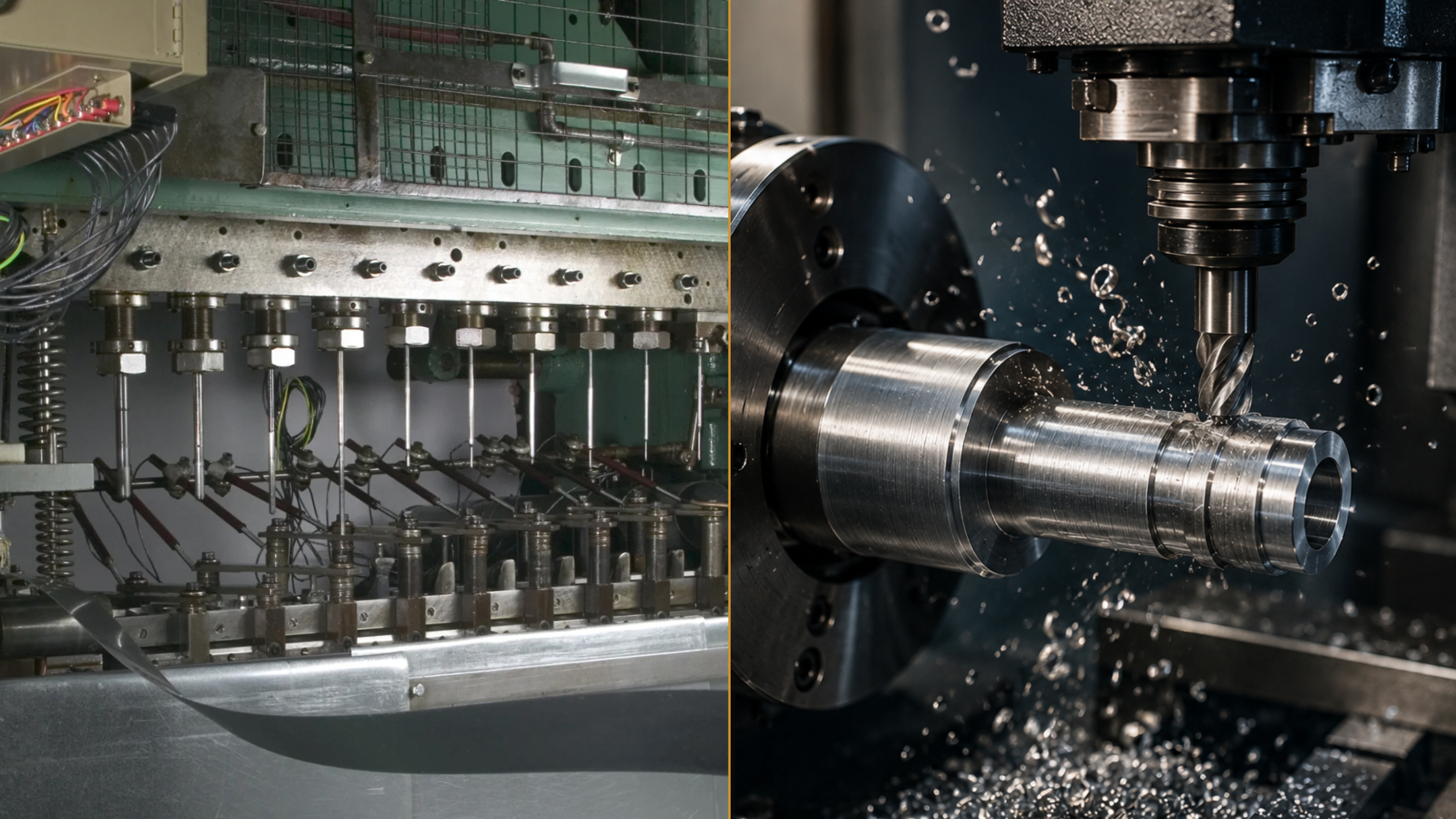
Deep Drawing vs CNC Machining: Comparing Cost, Speed, and Scalability
When you’re in the design phase of a new component, one of the earliest and most consequential decisions you’ll make is which metal forming process to use. The right choice optimizes cost, lead time, and long-term scalability from the start, setting your program up for a smoother path from prototype to full production.
For OEM engineers and supply chain leaders evaluating cylindrical, hollow, or seamless metal components, the comparison almost always comes down to two methods: deep drawing and CNC machining. They’re both capable of producing tight-tolerance parts, but they are built for fundamentally different scenarios.
What Each Process Does
Deep drawn metal forming starts with a flat sheet of metal and uses a series of punch-and-die stations to progressively shape the material into a three-dimensional part, typically cylindrical, cup-shaped, or tubular. The depth of the final part is usually greater than its diameter. No material is cut away; it’s stretched and formed. The result is a seamless, work-hardened part with walls of uniform thickness.
CNC machining is a subtractive process. It begins with a solid block of material and uses computer-controlled cutting tools to remove material until the desired geometry is achieved. CNC is highly flexible and capable of complex features, but every chip of metal removed is waste, and every setup takes time.
Where The Metal Forming Processes Diverge: Cost, Speed, and Scale
Cost-Per-Part at Volume
This is where deep drawing makes its strongest case. Because the process is fully automated and runs at high speed once tooling is established, the cost-per-part drops sharply as volume increases. Secondary operations such as beading, notching, piercing, and chamfering can often be integrated directly into the forming process when possible, eliminating additional processing steps and reducing overall production time.
CNC machining carries a different cost structure. Setup costs are fixed regardless of batch size, and machine time adds up quickly on complex geometries. Material utilization is also lower, since the subtractive process generates chip waste that deep drawing avoids almost entirely.
For high-volume runs of hollow or cylindrical parts, deep drawing consistently delivers a lower cost per unit. CNC machining becomes more competitive at low volumes or for prototype-stage quantities where tooling investment isn’t yet justified.
Speed and Lead Time
Once deep draw tooling is built, production is fast. Presses run continuously with automated feeding systems, and parts are ejected finished without manual intervention between stations. For established part geometries, this means high throughput and consistent cycle times.
CNC machining is more flexible at the setup stage but slower in production. Each job requires programming, fixturing, and operator oversight. For simple or medium-complexity parts in moderate volumes, CNC can be competitive on lead time. For runs measured in tens of thousands of units, deep drawing has a clear speed advantage.
Scalability
Scalability is the most decisive factor for teams planning production ramps. Deep drawn metal forming is scalable, the tooling is hard tooling specific to each job, and once validated, it produces identical parts at high volume without drift. Part-to-part uniformity is one of the process’s core strengths.
CNC machining scales differently. It can accommodate design changes more readily, but it doesn’t achieve the same throughput or cost efficiency at high volumes. For teams with stable designs and production forecasts, deep drawing offers a more reliable path to scalability.
Deep Drawing vs CNC Machining Comparison Chart
| Deep Drawn Forming | CNC Machining | |
| Process type | Formative (no material removal) | Subtractive (material removed) |
| Best volume range | Medium to high volume | Low to medium volume |
| Cost per part at scale | Low | Moderate to high |
| Material waste | Minimal — excess is trimmed and recycled | 30–40% typical chip waste |
| Tooling investment | Required upfront; amortized over volume | Lower upfront; higher recurring setup cost |
| Design changes | Requires new tooling | Program update; more flexible |
| Part strength | Work-hardened during forming | Dependent on stock material properties |
| Surface finish | Smooth, seamless, consistent | Good; may require secondary finishing |
| Secondary ops | Often integrated into press sequence | Typically separate operations |
| Lead time at volume | Fast once tooling is established | Consistent but slower per-unit |
When to Choose Deep Drawing
Industries where deep drawing dominates, including medical devices, automotive sensors, defense components, and precision writing instruments, share a common requirement: high-volume, repeatable parts that perform exactly the same way every time.
Deep drawing is the stronger choice when:
- The part is cylindrical, tubular, or cup-shaped with a depth greater than its diameter
- Production volumes justify the tooling investment
- The design requires seamless construction with no welds or joints
- Long-term cost-per-unit is a priority
- Consistent wall thickness, structural integrity, and tight tolerances are required
When CNC Machining Makes More Sense
CNC is the right call when:
- The part requires complex external geometry, internal threads, or features that deep drawing cannot achieve
- You’re in early prototyping and need design flexibility before committing to tooling
- Production quantities are low enough that tooling investment isn’t justified
- The material grade or part geometry is incompatible with the deep draw process
Starting with the Right Process: Why DFM Matters
The best way to avoid a costly process mismatch is to evaluate your design before committing to production tooling. At Accurate Forming, a manufacturability review at the design stage identifies whether a part is a strong candidate for deep drawing, or whether a different approach better fits the geometry, material, and volume requirements.
Accurate Forming works with OEMs across medical, automotive, defense, and industrial sectors to produce tight-tolerance components that meet demanding specifications.
If you’re evaluating a component in the design phase, get an early read on which metal forming process fits best.